
Hantavirus: Complete Guide to Causes, Symptoms, Risk Factors, Treatment and Prevention
Hantavirus is a name that most people only hear about when a new outbreak makes the news, yet this group of rodent-borne viruses has been quietly present in homes, farms, cabins and warehouses across the world for decades. It is rare, but it is also one of the most dangerous infections a person can pick up from something as ordinary as a mouse dropping in a garden shed. This guide breaks down everything worth knowing about hantavirus, what it actually is, how people catch it, the two very different disease patterns it can cause, who is most at risk, how doctors diagnose and treat it, and the exact steps that keep a home or workplace safe from it.
- 100+ Homes Serviced
- Licensed Texas Applicators
- Satisfaction Guaranteed
- Locally Owned & Operated
What Exactly Is Hantavirus?
Hantavirus isn’t a single virus, it’s a family of related viruses, each carried by a specific type of rodent. Different strains cause different illnesses depending on where in the world you are and which rodent species is involved. In North and South America, hantavirus strains are linked to a lung disease called Hantavirus Pulmonary Syndrome, often shortened to HPS. In Europe, Asia and parts of Africa, other strains cause a kidney disease called Hemorrhagic Fever with Renal Syndrome, or HFRS. One strain, Seoul virus, is unusual because it shows up almost everywhere in the world, carried by common brown rats rather than being tied to one region.
The virus itself doesn’t live long once it’s outside a rodent’s body, but it survives long enough in dust, dried droppings and old nesting material to become dangerous the moment that material is disturbed.
How Do People Actually Catch Hantavirus?
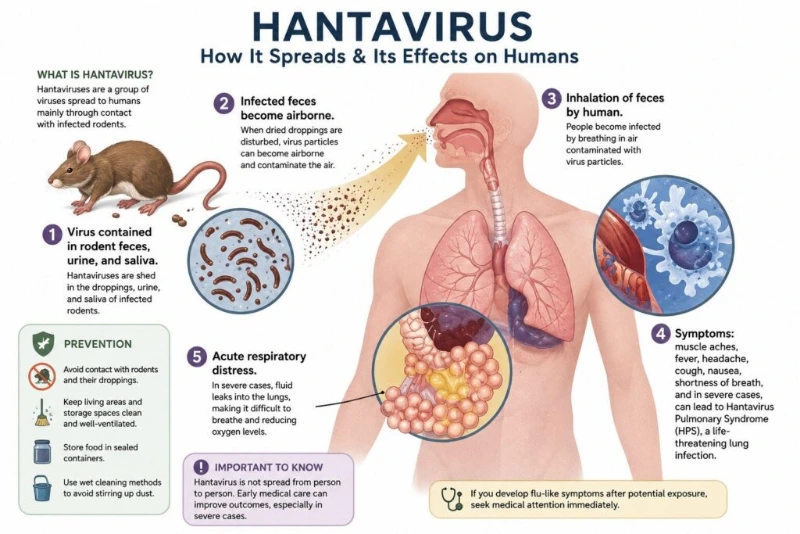
This is where a lot of people get it wrong, hantavirus isn’t spread by a bite in most cases, even though bites and scratches can rarely transmit it. The main route of infection is breathing in tiny virus particles that become airborne when dried rodent urine, droppings or nesting material gets stirred up. Sweeping a dusty shed floor, shaking out an old mattress in a cabin, or vacuuming a garage where mice have been nesting can all release these particles into the air without anyone noticing.
Less common ways of getting infected include:
- Touching a contaminated surface, like a rodent nest or droppings, and then touching your mouth, nose or eyes
- Eating food that a rodent has urinated or defecated on
- Being bitten or scratched by an infected rodent (rare)
There is one important exception to the “no person-to-person spread” rule. The Andes virus, found in Argentina and Chile and carried by the long-tailed pygmy rice rat, is the only hantavirus strain known to pass from an infected person to someone else, usually a close family member or caregiver in prolonged, close contact. This strain made headlines again in 2026 after an outbreak aboard the cruise ship MV Hondius, though the outbreak was ultimately contained with no cases confirmed among U.S. or California residents.
The Rodents Behind Hantavirus
Every hantavirus strain has its own animal host, and knowing which rodent carries which strain helps explain why certain regions see more cases than others.
- Deer mouse — carries Sin Nombre virus, the main cause of HPS in the United States, especially in states west of the Mississippi River
- Rice rat and cotton rat — found in the southeastern U.S., also linked to HPS-causing strains
- White-footed mouse — a carrier in the northeastern United States
- Long-tailed pygmy rice rat — carries Andes virus in South America
- Vesper mouse — spreads Laguna Negra virus in parts of South America
- Brown rat — carries Seoul virus, found worldwide including in the U.S.
- Various field mice and voles across Europe and Asia carry Hantaan, Dobrava, Puumala and Saaremaa viruses, all linked to HFRS
Because deer mice are common throughout rural and semi-rural California and much of the western U.S., health departments there track a small but steady number of Sin Nombre virus infections every year, California alone typically logs around three confirmed cases annually.
Two Very Different Diseases, One Virus Family
Hantavirus Pulmonary Syndrome (HPS)
HPS is the disease pattern seen in the Americas, and it moves in two distinct phases. Symptoms typically begin somewhere between one and eight weeks after exposure, though two to four weeks is the more common window.
The early phase feels a lot like the flu:
- Fever and chills
- Deep muscle aches, particularly in the thighs, hips, back and shoulders
- Fatigue
- Headache
- In many patients: nausea, vomiting, diarrhea or stomach pain
This is exactly why HPS is so easy to miss early on, it mimics influenza or even COVID-19 closely enough that rodent exposure is often the only clue pointing doctors in the right direction.
Around four to ten days later, the disease can turn serious very quickly. Fluid begins building up in the lungs, breathing becomes difficult, and the heart can struggle to keep blood pressure stable. This late stage is why HPS carries such a high fatality rate, roughly a third to just under 40% of patients who reach the respiratory stage do not survive, and the deadliest strains carry mortality figures as high as 50%.
Hemorrhagic Fever with Renal Syndrome (HFRS)
HFRS follows a different pattern and targets the kidneys instead of the lungs. It’s the dominant hantavirus disease across Europe and Asia. Symptoms usually show up within one to two weeks of exposure, though in some cases it can take as long as eight weeks.
Early signs include:
- Sudden, intense headaches
- Fever and chills
- Pain in the back and abdomen
- Nausea
- Blurred vision
- Flushed skin, red eyes, or a rash in some patients
As the illness advances, it can cause dangerously low blood pressure, internal bleeding, fluid overload and acute kidney failure requiring dialysis. How dangerous HFRS turns out to be depends heavily on which strain is responsible. Hantaan and Dobrava virus infections are the most severe, with fatality rates between 5% and 15%, while Seoul, Saaremaa and Puumala virus infections are milder, killing fewer than 1% of those infected. Recovery from HFRS, even in mild cases, can take several weeks to months.
Who Is Most at Risk?
Hantavirus doesn’t discriminate by age or health status the way many other infections do, exposure is really about environment and activity rather than personal vulnerability. People most likely to encounter the virus include:
- Anyone opening up a cabin, barn, shed or storage building that’s been closed for a season
- Construction, utility, and pest-control workers
- Farmers and agricultural workers
- Campers and hikers using rustic shelters (a well-documented cluster of cases occurred among overnight visitors to Yosemite National Park)
- Homeowners cleaning basements, attics or crawl spaces where rodents have nested
How Doctors Diagnose Hantavirus
Diagnosis is genuinely tricky in the first three days of illness because the virus may not yet be detectable in blood tests, and the symptoms overlap so heavily with common respiratory illnesses. Doctors often need to repeat testing after 72 hours if the first test comes back negative but suspicion remains high. Mentioning any possible rodent exposure, even something as small as finding droppings in a garage, is often the detail that leads a physician toward the right diagnosis. Confirmed testing is generally carried out through state public health laboratories working alongside national health agencies.
Treatment: Why Supportive Care Is the Only Option
There is no antiviral drug or specific cure for hantavirus infection. Every part of treatment is supportive, meaning doctors manage symptoms and keep the body functioning while the immune system fights the infection on its own.
For HPS, this often means hospital oxygen support, and in severe cases, mechanical ventilation or ECMO (extracorporeal membrane oxygenation), a life-support technique that takes over the work of the lungs and heart when they can no longer keep up on their own.
For HFRS, treatment centers on protecting kidney function, monitoring fluid balance closely, and providing dialysis if the kidneys fail. Early medical attention, even without a cure available, significantly improves the odds of survival for both diseases.
Preventing Hantavirus: The Practical Steps That Actually Work
Because there’s no vaccine and no cure, prevention is genuinely the only reliable defense, and thankfully it comes down to a short list of concrete habits.
Keep rodents out in the first place:
- Seal any gap wider than a quarter inch with steel wool, wire mesh, cement or metal flashing — deer mice can squeeze through surprisingly small openings
- Store food, including pet food, in rodent-proof containers with tight lids
- Clear brush, tall grass, woodpiles and compost bins away from the base of buildings
- Use spring-loaded snap traps rather than glue or live traps
If you find droppings, a nest, or signs of an infestation, never sweep or vacuum the area. This is the single most repeated warning from health agencies, because sweeping and vacuuming are exactly what launches virus particles into the air. Instead:
- Air out the space for at least 30 minutes before entering to clean
- Wear rubber or plastic gloves, and a respirator mask if the area is heavily infested
- Spray the contaminated area generously with a disinfectant or a fresh 10% bleach solution and let it sit for five minutes
- Wipe up using paper towels, a sponge or a mop, never dry sweeping
- Dispose of used towels and gloves properly, then wash your hands thoroughly with soap and water
These same steps apply whether you’re opening a seasonal cabin, cleaning a garage, clearing a barn, or dealing with a rodent problem in a city apartment.
The Bigger Picture
Hantavirus remains rare compared to other infectious diseases, U.S. surveillance has recorded fewer than 900 confirmed cases since tracking began in the early 1990s, but its high fatality rate for HPS in particular means awareness matters far more than the raw numbers suggest. Most cases cluster in rural parts of the western United States, but confirmed infections have turned up in 40 different states, plus countless more across Europe, Asia and South America under different strain names. The pattern holds everywhere: wherever rodents and humans share close quarters, hantavirus stays a quiet but real risk, and simple prevention habits remain the most effective protection anyone has against it.
This article is for general educational purposes. If you suspect rodent exposure and are experiencing flu-like symptoms, seek medical care promptly and mention the possible exposure to your doctor.
About Us
Rodent Proof Katy is a local, rodent-only team specializing in rat removal, mice exclusion, attic cleanup, and crawl-space decontamination across Katy, TX. We understand how Katy’s rapid growth, humid subtropical climate, and builder-grade construction gaps let rodents in, and we build permanent, photo-documented fixes for it. No shortcuts, no guesswork, no scare tactics, just a clear plan and a home that stays quiet.
Contact Us
Our Address: 4631 11th St, Brookshire, TX 77423
Email: info@rodentcontrolkaty.com
Phone: +1 (281) 501-7677
