
Our Rodent Control Process in Katy, TX — From First Call to a Permanently Quiet Attic
Stop guessing with monthly pest subscriptions. From Cinco Ranch to Elyson, our TDA-licensed 6-step rodent control process eliminates rats and mice at the source. We use Gulf Coast-rated materials, photo-documented inspections, and humane exclusion, backed by our ironclad 90-day return protection.
- 100+ Homes Serviced
- Licensed Texas Applicators
- Satisfaction Guaranteed
- Locally Owned & Operated
Six Defined Steps. No Poison Dumped in Attics. No Open-Ended Contracts.
Every rodent job in Katy follows the same six-step system, whether it’s a single house mouse in a Cinco Ranch pantry or a full roof rat colony in an Old Katy attic. No guesswork, no “we’ll just keep coming back and billing you” subscriptions, a defined start, a defined finish, and a written photo record of everything in between.
TDA Structural Pest Control–Licensed · Gulf-Coast-Rated Materials.
Same/Next-Day Service · 90-Day Return Protection
Step 1 — Phone Triage: Species Identified Before We Ever Knock
Every job starts with a short call, not a truck showing up blind. We ask what you’re hearing and when, scratching and running along the ceiling at night usually points to roof rats using the attic as a highway between tree canopy and rooflines; quiet scurrying near the kitchen or pantry, especially at dawn or dusk, usually means house mice working a food source at ground level; digging or burrow holes near the foundation or slab edge points to Norway rats.
We also ask about your home’s age and construction (new-construction Elyson or Jordan Ranch build vs. an older Old Katy home with mature trees), whether the sounds are coming from the attic, garage, or kitchen wall, and whether there are kids, pets, or gate/HOA access codes we need on file before dispatch. By the end of the call we already have a working species hypothesis, which changes what equipment rides in the truck and where the technician starts looking first.
Why this step matters: A technician arriving prepared for a roof rat attic job when the real problem is ground-level house mice near the pantry wastes the visit and delays the real fix. Triage is how we avoid that.
Step 2 — Full Inspection & Photo Mapping
This is the step most general pest companies skip or shortcut, and it’s the one that actually determines whether a rodent problem comes back in six weeks. Roof rats don’t climb exterior walls — they come in from tree limbs and power lines onto the roofline, which means a ground-level walk-around alone misses the majority of active entry points on a Katy home. Our inspection includes:
- Roofline and attic access — checking ridge vents, gable vents, and rafter gaps where roof rats and mice are most active
- Weep holes — the single most common entry point into newer Katy subdivisions like Elyson, Cane Island, and Jordan Ranch, where builder-grade brick drainage gaps go unsealed
- Foundation and slab edges — where Norway rats burrow, especially on lots near greenbelts and retention ponds
- Garage and AC line penetrations — a common gap on new-construction homes still settling
- Crawl space and vapor barrier condition on pier-and-beam homes
Every candidate entry point is photographed and severity-rated, A (confirmed active), B (high probability), C (monitor), so you’re not taking our word for it. You get the written photo report the same day, and the inspection fee is credited in full toward any approved work.
Step 3 — Humane Trapping & One-Way Exits
We don’t start sealing anything until the interior population is confirmed clear, sealing too early traps animals inside the structure, which leads to chewed drywall, dead rodents in wall cavities, and an odor problem that’s far worse than the original noise complaint.
Traps and one-way exclusion devices are placed same-day or next-day along confirmed travel routes, the dark, oily “grease runs” that mark where rats and mice move night after night, not scattered randomly through the attic. One-way doors let existing rodents leave the structure without letting new ones back in, which is why we rarely need rodenticide bait inside a living attic space. Trapping continues until activity stops, confirming the space is clear before we move to permanent sealing.
Step 4 — Permanent Exclusion & Sealing
This is the step that actually stops the problem from returning, and it’s why materials matter as much as labor. Katy’s humid, Gulf Coast climate, heavy spring and fall rain, high humidity, and mild winters, breaks down cheap foam and plastic mesh within a season or two. We use:
- ¼-inch stainless steel hardware cloth for all mesh openings, rust-resistant against Gulf Coast humidity
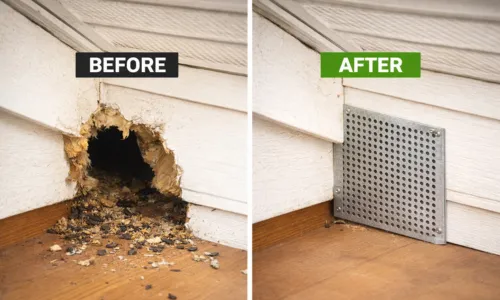
- Corrosion-resistant weep-hole covers that seal the gap without blocking the brick drainage weep holes are designed for
- Galvanized flashing at fascia, foundation sill, and other structural gaps that need a rigid seal rather than mesh
- Sealed gable and ridge vents to close off the roofline access points roof rats use most
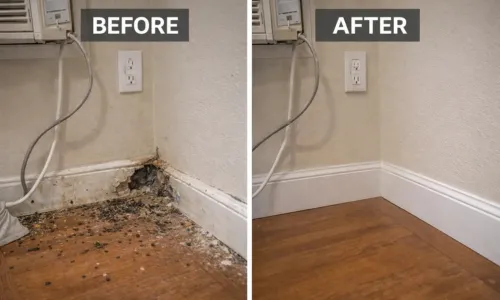
Every sealed point is photographed after installation, so the before/after record shows exactly what was closed and where, organized by location, not a verbal summary.
Step 5 — Sanitize, Restore & Monitor
Once a colony has been active in an attic, the droppings, urine, and nesting material left behind aren’t just an odor problem, they’re a sanitation issue, and in enough volume they can carry salmonella and other bacteria that spread through contaminated dust. Our cleanup includes HEPA-vacuum removal of droppings and nesting debris, an enzyme-based deodorizer applied to travel routes, and insulation restoration where nesting or waste has compacted or soiled existing material. Scent trails left behind can otherwise signal “established territory” to new rodents probing the same entry points later, so this step is part of preventing a repeat call, not just cleanup.
Step 6 — Written Report & 90-Day Return Protection
Every job closes with a written, photo-documented report: what was found, what species was confirmed, every entry point sealed with a before/after photo, and any wiring or insulation damage noted for follow-up. This isn’t a verbal “all set” — it’s documentation you can hold onto, show a future buyer, or hand to a property manager if you’re a landlord.
From there, the 90-Day Return Protection starts. If rodent activity returns through any point we sealed within 90 days, we come back and fix it at no charge. No fine print, no deductible, no “that’s a different service call.”
Why Skipping a Step Causes the Problem to Come Back
Skip the phone triage → wrong equipment, wrong starting point, wasted first visit.
Skip the roofline/weep-hole inspection → the majority of active entry points on Katy homes go unnoticed, because a ground-level walk alone doesn’t catch what’s happening at the roofline or in builder-grade weep holes.
Skip or rush trapping → sealing with rodents still inside creates a trapped colony that chews through drywall trying to get out.
Seal with foam or plastic mesh instead of Gulf-Coast-rated materials → the seal degrades within one or two humid Katy seasons, and the same entry point reopens.
Skip sanitation → leftover scent trails recruit the next generation of rodents through any future gap, even after sealing.
Skip the written report → no documentation for a home sale, an HOA dispute, or a landlord’s lease file — and no enforceable guarantee.
Our Process vs. a Typical Monthly Pest Subscription
| What Matters | Monthly Subscription Model | Our 6-Step Process |
|---|---|---|
| Inspection depth | Ground-level walk-around, or none | Roofline, attic, weep holes, foundation, fully photo-mapped |
| Entry-point sealing | Rarely included, or bait stations only | ¼” stainless mesh, weep-hole covers, galvanized flashing |
| End date | None, billed indefinitely | Defined close-out with written report |
| Documentation | Verbal summary | Photo-documented, before/after, by location |
| Guarantee | Varies by provider | 90-Day Return Protection, no exceptions |
| Materials | Standard foam/plastic mesh | Gulf-Coast-rated stainless & galvanized |
Got Questions?
We’re happy to help. If you can’t find the info you’re looking for, please don’t hesitate to reach out to us!
Ready to Start? Same/Next-Day Rodent Control Across Katy, TX TDA-Licensed Applicators · Gulf-Coast-Rated Exclusion Materials · Photo-Documented Reports · 90-Day Return Protection
About Us
Rodent Proof Katy is a local, rodent-only team specializing in rat removal, mice exclusion, attic cleanup, and crawl-space decontamination across Katy, TX. We understand how Katy’s rapid growth, humid subtropical climate, and builder-grade construction gaps let rodents in, and we build permanent, photo-documented fixes for it. No shortcuts, no guesswork, no scare tactics, just a clear plan and a home that stays quiet.
Contact Us
Our Address: 4631 11th St, Brookshire, TX 77423
Email: info@rodentcontrolkaty.com
Phone: +1 (281) 501-7677
